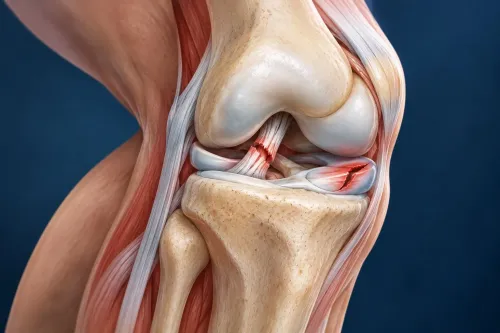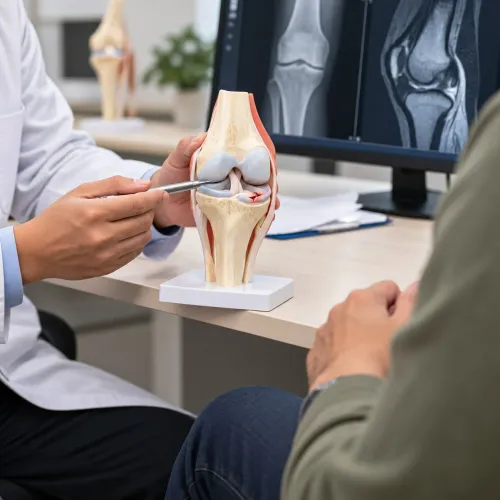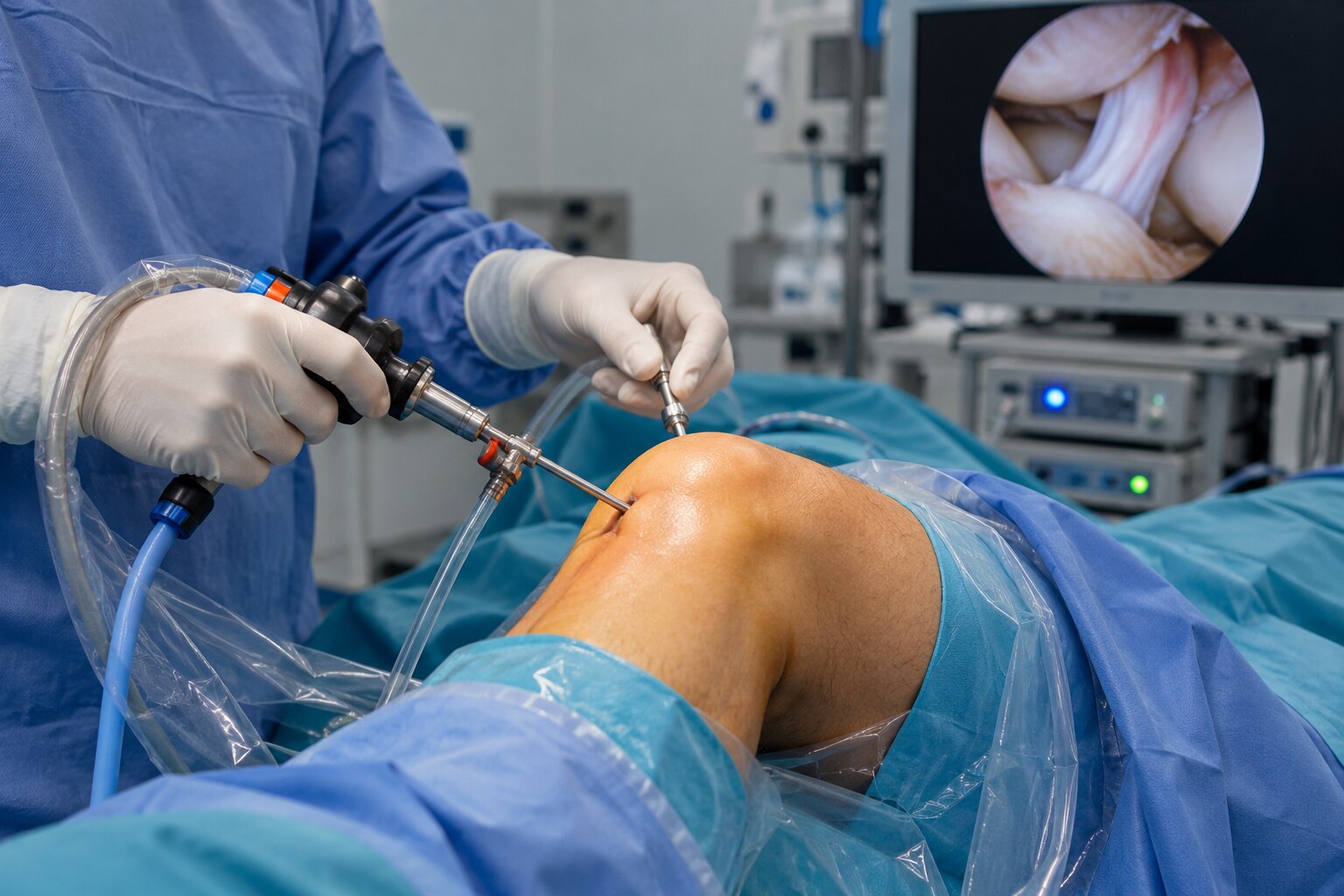
A serious knee injury does not automatically mean you need reconstruction, and a normal-feeling knee does not prove that the ligaments are intact. You will learn how doctors identify the damaged structure, compare surgery with rehabilitation, understand graft and recovery trade-offs, and recognise when reconstruction is unlikely to solve the whole problem.
Key takeaways
- MRI and physical tests identify the injured ligament and guide treatment decisions.
- Graft choice affects strength, recovery demands, pain and future knee risks.
- Prehabilitation restores motion and swelling control before reconstruction surgery.
- Return to running and sport depends on strength, control and functional testing.
How doctors identify the damaged ligament and decide whether surgery fits
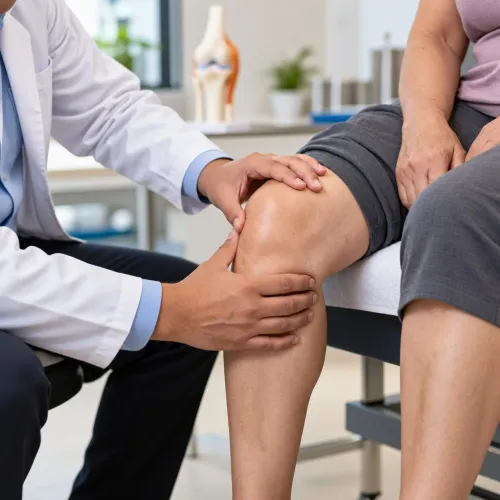
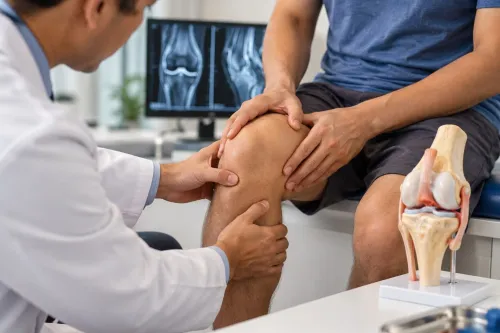
A normal-feeling knee immediately after injury does not prove the ACL is intact. Doctors combine the injury history with a ligament injuries exam: the Lachman, pivot-shift and anterior drawer tests assess ACL looseness, while posterior-drawer, valgus-stress and varus-stress tests assess PCL, MCL and LCL injuries.
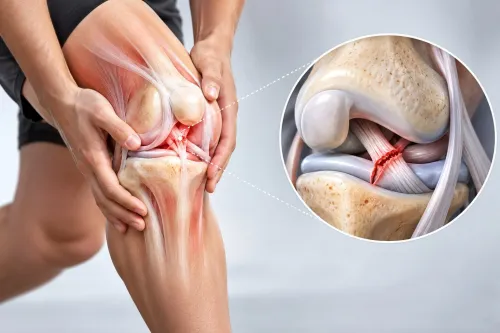
MRI clarifies damage to the ligament, meniscus, cartilage and bone, but it does not replace the stability examination.
| Finding | Reconstruction is more likely to help | Nonoperative treatment may be enough |
|---|---|---|
| Instability | Repeated giving-way, a positive pivot-shift, or combined ACL, PCL, MCL or LCL injury | A stable knee after rehabilitation with no recurrent giving-way |
| Activity demands | Pivoting sport, heavy manual work, or a need for dependable cutting and landing stability | No need to return to pivoting activity and willingness to use activity modification |
| Associated damage | Repairable meniscus damage, cartilage injury, or poor knee alignment that increases joint loading | No major meniscus or cartilage injury and acceptable knee alignment |
An ACL tear alone does not automatically require surgery. Structured nonoperative treatment can include physiotherapy, quadriceps and hamstring strengthening, bracing and activity modification, particularly when the knee remains stable. Reconstruction becomes more persuasive when instability persists, a repairable meniscus is at risk, or several ligaments are torn.
Doctors also restore full extension, reduce swelling and improve quadriceps control before operating; a swollen, stiff knee has a higher risk of postoperative stiffness. MRI findings, examination results and your goals must agree before reconstruction is chosen.
What reconstruction does inside the knee and how graft choice changes the trade-offs
Reconstruction replaces a torn ligament with a tendon graft rather than stitching the usual ACL back together. The surgeon removes unusable remnants, drills bone tunnels in the femur and tibia, passes the graft through them, and secures it with graft fixation devices while it incorporates and remodels.
The same principle can apply to PCL, MCL or LCL injuries, depending on the tear pattern and associated damage. Ligament repair versus reconstruction means stitching a repairable native ligament, often near its attachment, versus replacing it when tissue quality or separation prevents reliable healing.
| Option | Main advantage | Main trade-off | Often suits |
|---|---|---|---|
| Patellar tendon graft | Bone-to-bone fixation | Anterior knee pain, kneeling pain and donor-site pain | Athletes needing strong restraint who do not kneel for work |
| Hamstring tendon graft | Smaller harvest-site symptoms and less kneeling pain | Hamstring weakness and slower tendon incorporation | Running athletes or workers who kneel frequently |
| Quadriceps tendon graft | Thick, strong autograft with another harvest site | Donor-site pain or temporary quadriceps weakness | Larger patients, revision cases or high-demand athletes |
| Donor allograft | No tendon harvest and no donor-site pain | Higher graft-failure risk in young or active patients | Selected older or lower-demand patients |
Your sport and job help decide the match. A football player who cuts and pivots may favour an autograft despite harvest-site symptoms; a floor installer may prioritise avoiding kneeling pain. Discuss previous surgery, age, strength deficits and symptoms, because there is no universally best graft.
Why timing, prehabilitation and the operation itself affect the result
A swollen stiff knee is a poor starting point for reconstruction because limited extension and quadriceps inhibition increase the risk of postoperative stiffness. Surgery timing therefore depends on swelling, range of motion, walking ability and quadriceps control, not simply the date of injury.
For an unstable ACL, delaying too long can expose the knee to further meniscal or cartilage damage; the AAOS says reconstruction within three months may reduce additional meniscal damage when surgery is indicated.
Before the operation, prehabilitation targets:
- Reduced swelling and pain
- Full knee extension and improving flexion
- Reliable quadriceps control
- Safe walking without a major limp
Prehabilitation does not “heal” a completely torn ligament. It gives you a better-functioning knee to operate on and makes early rehabilitation more productive.
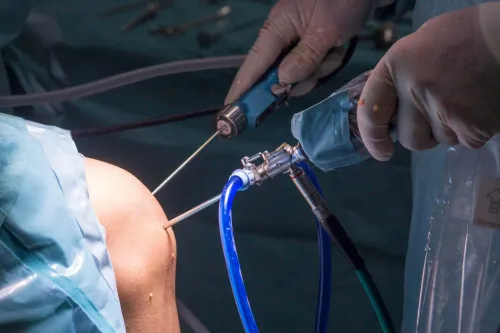
On surgery day, anaesthesia is arranged before arthroscopy allows the surgeon to inspect the joint and address findings such as a meniscal repair or cartilage damage. The team completes graft preparation, drills the required tunnel placement, and secures the graft with fixation devices.
A meniscal repair can require stricter limits on weight-bearing or knee bending than an isolated reconstruction.
Afterward, the plan depends on the procedure and your medical needs. Some patients leave under same-day care; others need overnight care for pain control, mobility checks or observation. Ask before admission what brace, crutch, medication and exercises start that day.
What recovery requires before you can return to work, running or sport
You return to work, running or sport when your knee meets functional milestones, not simply because a calendar says it is time. Early physiotherapy focuses on swelling control, full extension, bending, quadriceps activation and safe walking.
Crutches and a knee brace protect healing while weight-bearing advances; a meniscus repair can require longer limits than an isolated reconstruction.
| Stage | Main work | Progression or restriction |
|---|---|---|
| Early recovery | Home exercises, motion, swelling control, crutches and brace use | Avoid twisting; follow weight-bearing limits |
| Strength phase | Strength training and neuromuscular training | Do not advance if swelling returns or the knee gives way |
| Running phase | Straight-line running, then faster running | Start only with full motion, minimal swelling and controlled single-leg movement |
| Sport phase | Deceleration, cutting, jumping and sport drills | Add direction changes only after strength and landing control improve |
| Testing | Hop tests, strength symmetry and psychological readiness | Return to sport requires acceptable results across the testing programme |
Driving requires adequate control of the pedals, safe braking, medical clearance and no sedating pain medicine. Stair use should be slow, supported and step-by-step until single-leg control returns. Sleep improves when you support the leg comfortably without forcing the knee into a painful position.
Your work restrictions depend on the job: desk work may resume before prolonged standing, while heavy work, lifting, kneeling and ladder use need stronger control. Stop and contact your clinician for increasing swelling, locking, wound drainage or calf pain.
A stable-feeling graft is not permission to skip rehabilitation; weak muscles and poor movement raise reinjury risk.
How to weigh complications, long-term expectations and your treatment plan
The decision weighs stability against surgical risk and the work of recovery. Complications include infection, blood clots, stiffness, graft failure, persistent instability, nerve or blood-vessel injury, anterior knee pain and donor-site pain. Seek urgent care for fever, increasing drainage, calf swelling, shortness of breath, or a cold, discoloured foot.
Reconstruction is not interchangeable with joint replacement or rehabilitation alone.
| Option | What it means | When it applies |
|---|---|---|
| Ligament reconstruction | A graft restores restraint to an unstable knee; it does not remove arthritis or guarantee protection from osteoarthritis. | Instability affects work, daily activity or sport after appropriate assessment. |
| Rehabilitation alone | Strength, balance and movement training support a stable knee without graft fixation. | Symptoms settle and you can function without repeated giving-way episodes. |
| Knee replacement or partial knee replacement | Damaged joint surfaces are replaced, not the torn ligament alone. | Severe osteoarthritis drives pain and disability; partial replacement fits disease confined to one compartment. |
Ask these consultation questions before choosing surgery:
- How does your surgeon experience with this ligament, associated meniscus or cartilage damage, and similar activity levels affect the recommendation?
- Which graft and fixation method suit your age, sport, kneeling demands and previous operations, and what donor-site pain or weakness could follow?
- What is the specific rehabilitation plan, including work, driving and return-to-sport tests?
- What finding would make rehabilitation alone reasonable, and when would knee replacement be more appropriate?
Dr Ronak Kothari can use this discussion to separate knee-preservation goals from treatment aimed at established arthritis.
Related services
Knee Preservation Procedures Dr. Ronak Kothari, an experienced Orthopaedic Surgeon, specializes in Knee Preservation Procedures aimed at maintaining the natural knee joint for as... View service → |
General Consultation ₹1000 General Consultation |
Frequently asked questions
How do doctors identify a damaged knee ligament?
Doctors review how the injury happened, examine knee looseness with tests such as the Lachman and pivot-shift, and use imaging when needed to confirm the injury and assess other damage.
How does ligament reconstruction restore knee stability?
The surgeon removes the damaged ligament tissue when needed and positions a tendon graft through bone tunnels to recreate the ligament’s stabilising path.
How does graft choice affect ligament reconstruction?
Patellar tendon, hamstring tendon, quadriceps tendon and donor-tissue grafts involve different trade-offs in fixation, pain, strength recovery, graft failure risk and rehabilitation demands.
When can you return to work, running or sport after reconstruction?
Timing depends on your job, graft healing, knee motion, swelling, strength and movement control. Running and pivoting sports require progressive rehabilitation and objective readiness testing.