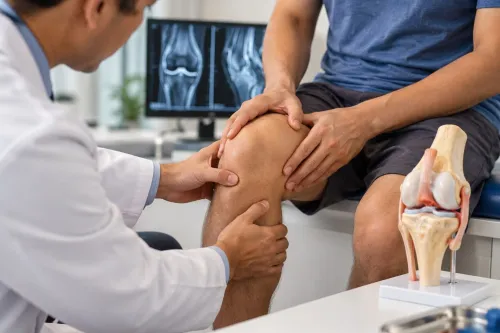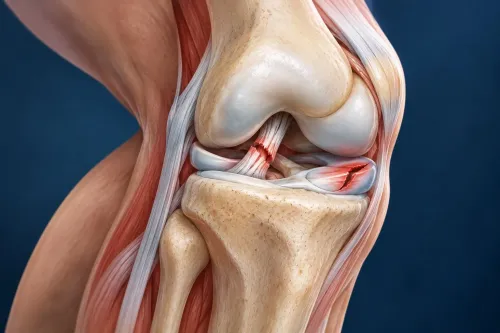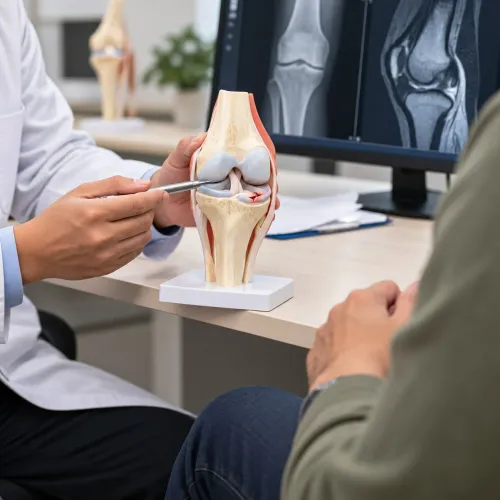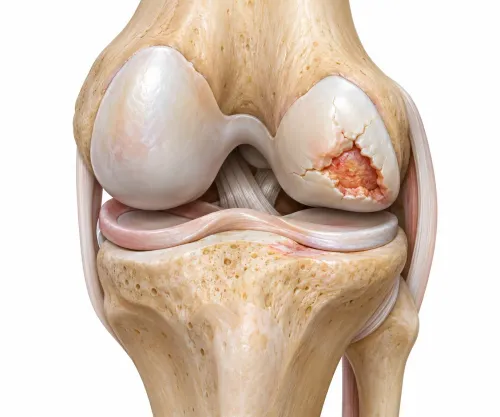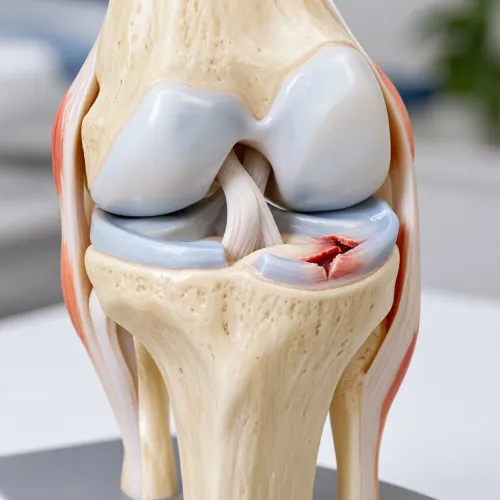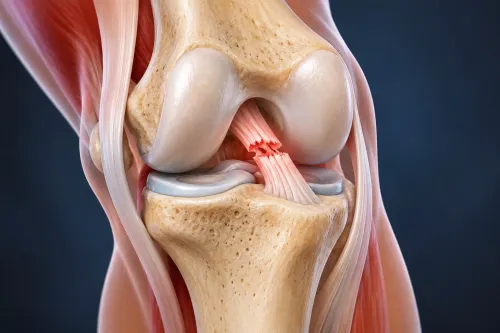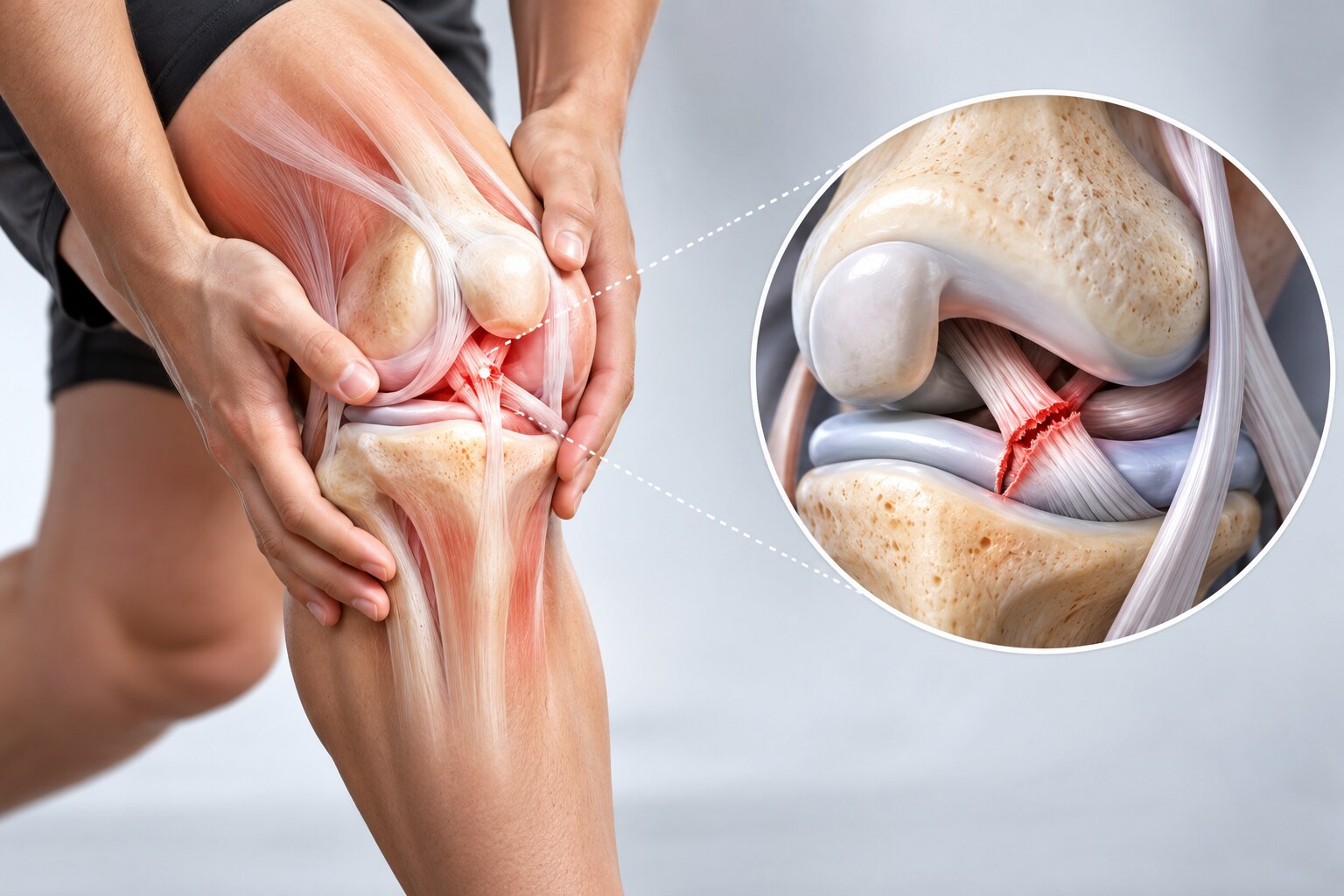
A twisting pivot, awkward landing, direct blow, or sudden stop can damage more than one structure in the knee, and swelling alone cannot identify the injury. By the end, you will know which warning signs need prompt assessment, how clinicians confirm a ligament tear, and when bracing and rehabilitation are enough or surgery deserves consideration.
Key takeaways
- Seek emergency care for deformity, a cold foot, absent pulses, numbness, or severe disproportionate pain.
- The injury mechanism and examination guide testing with MRI, X-rays, or vascular assessment.
- Rehabilitation may be enough for some tears; instability, combined injuries, or high-demand sport can favour surgery.
- Progress strength, stability, swelling, and movement before returning to activity.
Which knee injury symptoms need prompt or emergency assessment?
Seek emergency care immediately for a visible deformity or dislocation, a cold pale foot, absent foot pulses, new numbness or weakness, or severe pain out of proportion to the injury. A knee dislocation can stretch or tear nearby blood vessels and nerves even when the joint seems to have moved back into place.
| Finding | What it may indicate | What to do |
|---|---|---|
| Knee gives way or inability to bear weight | Major ligament, fracture, or joint injury | Prompt clinical assessment |
| Rapid knee swelling within hours | Bleeding inside the joint from an ACL tear, fracture, patellar dislocation, or another significant injury | Same-day assessment; it does not prove ACL surgery is needed |
| Locked knee after injury | Displaced meniscus tear or another mechanical obstruction | Prompt orthopaedic assessment |
| Visible deformity, numbness, cold pale foot, or absent pulse | Possible knee dislocation with vascular or nerve damage | Emergency department immediately |
A locked knee that cannot fully straighten differs from stiffness caused by pain. Do not wait for routine strengthening to resolve it. Persistent swelling, restricted motion, severe pain, or instability also deserves review, because pain relief alone does not show that a ligament has healed or that pivoting activity is safe.
What does the injury mechanism suggest, and how is a ligament tear confirmed?
A twisting pivot, sudden deceleration, or awkward landing points toward a possible ACL injury. A direct blow to the front of the shin suggests a PCL injury, while a force pushing the knee inward suggests an MCL injury and a force pushing it outward suggests an LCL injury mechanism.
Hyperextension can damage a ligament, capsule, meniscus, cartilage, or bone.
Bruising, swelling, restricted motion, and instability raise concern but cannot confirm a tear. Some people compensate well despite significant damage, while swelling can also follow a fracture, dislocation, or meniscus injury.
1. The clinician records how the knee moved, where the force struck, whether a pop occurred, how quickly swelling developed, and whether the knee has given way.
2. Inspection checks swelling, bruising, alignment, and deformity. Range-of-motion testing shows whether pain, swelling, or a mechanical block prevents full bending or straightening.
3. Hands-on tests assess specific structures: the Lachman, anterior-drawer, and pivot-shift tests examine ACL stability; the posterior-drawer test examines the PCL; valgus-stress testing assesses the MCL; and varus-stress testing assesses the LCL.
4. A plain X-ray checks for fracture, dislocation, or an avulsion fragment pulled off with the ligament. MRI evaluates the ACL, PCL, MCL, LCL, menisci, cartilage, and bone bruising, but the scan must be interpreted alongside your symptoms and examination findings.
How do ACL, PCL, MCL, and LCL tears differ in treatment?
The ligament named on an MRI does not decide treatment by itself; instability, tear severity, associated damage, and your activity demands matter more.
| Ligament | Main problem | Common treatment direction |
|---|---|---|
| ACL | Forward and rotational instability, especially with cutting, pivoting, or landing | ACL tear treatment ranges from bracing and rehabilitation to reconstruction |
| PCL | Reduced control of backward movement of the shin | PCL injury nonoperative treatment can work when the knee remains functionally stable |
| MCL | Inner-knee instability | Grade I and most Grade II isolated injuries often receive activity modification, early motion, strengthening, and an MCL tear hinged brace |
| LCL | Outer-knee instability | Assess carefully for posterolateral-corner or other ligament damage |
An isolated partial ligament tear, and some complete tears without functional instability, can be managed without surgery through modified activity, bracing, physiotherapy, and progressive strength and balance training. Partial ligament tear physiotherapy is not a lesser form of treatment; it aims to restore dependable control before you resume demanding movement.
Treatment requires a higher level of assessment when you have a selected Grade III MCL injury, persistent PCL instability despite rehabilitation, an LCL injury instability pattern suggesting posterolateral-corner damage, a bony avulsion, knee dislocation, or combined ligament injuries.
Repeated giving-way matters because it can lead to further meniscus or cartilage damage, even when pain has eased.
When does surgery become more important than rehabilitation alone?
Surgery becomes more important when the knee repeatedly buckles, remains unstable after a structured rehabilitation programme, or must withstand demanding work or sport. An abnormal MRI label alone does not decide when ACL surgery is needed; recurrent giving way, examination findings, and activity demands matter more than the scan.
| Situation | Why a procedure enters discussion | What may change the decision |
|---|---|---|
| Repeated giving-way episodes | Uncontrolled movement can lead to further meniscus or cartilage damage | Stable examination and successful rehabilitation |
| Complete ACL rupture in a pivoting athlete | Cutting, landing, and rapid direction changes require dependable rotational control | Lower-demand activity without functional instability |
| Combined ligament and meniscus injury with persistent instability | Several damaged structures may not stabilise the knee through rehabilitation alone | Healing of the associated injury and restored control |
| Persistent PCL instability | Backward shin movement remains poorly controlled despite rehabilitation | Functional stability after bracing and strengthening |
| Work or sport requiring dependable knee control | Unpredictable buckling creates safety and performance problems | Modified duties or a change in activity |
Before ACL reconstruction, prehabilitation usually targets full knee extension, reduced swelling, and improved strength. Operating on a stiff, inflamed knee raises concern about postoperative loss of motion, so preparation does not mean surgery has been abandoned.
ACL reconstruction usually replaces the ligament with a graft rather than simply stitching it. Graft options include patellar tendon, hamstring tendon, quadriceps tendon, or donor tissue; each has different trade-offs. An orthopaedic knee assessment with Dr Ronak Kothari can match examination findings, goals, imaging, and treatment timing.
Related services
Knee Preservation Procedures Dr. Ronak Kothari, an experienced Orthopaedic Surgeon, specializes in Knee Preservation Procedures aimed at maintaining the natural knee joint for as... View service → |
Knee Arthroscopy & Sports Medicine Knee Arthroscopy & Sports Medicine Dr. Ronak Kothari, a skilled Orthopaedic Surgeon, specializes in Knee Arthroscopy and Sports Medicine, offering advanced, minimally invasive... View service → |
How do you know whether treatment is working and the knee is ready for activity?
Treatment is working when swelling settles, motion returns, strength improves, and the knee remains stable during progressively harder tasks. Pain relief alone does not prove that a ligament has healed or that pivoting is safe.
Use these checkpoints during ligament tear rehabilitation:
- Persistent swelling, loss of motion, or recurrent instability warrants a review. Repeated buckling can contribute to meniscus or cartilage damage.
- A knee that is difficult to move because of pain is different from a true locked knee that cannot fully straighten. A locked knee needs prompt orthopaedic assessment for a displaced meniscus tear or another mechanical obstruction.
- Progress from swelling control and restored range of motion to strengthening, balance, movement control, and sport-specific drills.
- Before return to sport after ACL injury, clinicians commonly assess full or near-full motion, stable swelling, side-to-side strength symmetry, single-leg control, balance, landing mechanics, and knee strength balance functional testing.
- Do not use elapsed weeks or months as the only clearance test. A knee that still gives way is not ready for cutting, pivoting, jumping, or contact activity.
Return for review if progress stalls, swelling returns after exercise, extension remains limited, or the knee buckles even once during rehabilitation. These findings need reassessment rather than simply more time. Clearance should follow examination and functional performance, whether treatment was nonsurgical or surgical.
Frequently asked questions
Which knee injury symptoms need prompt or emergency assessment?
Seek emergency care for a visible deformity or dislocation, a cold pale foot, absent foot pulses, new numbness or weakness, or severe pain out of proportion to the injury. A knee dislocation can damage blood vessels and nerves even after the joint returns to position.
How is a knee ligament tear confirmed?
The clinician considers how the injury happened, checks swelling, movement, tenderness, stability, circulation, and nerve function, then uses imaging. X-rays identify fractures, while MRI shows ligament and other soft-tissue damage. Vascular testing is needed when circulation is a concern.
When does surgery become more important than rehabilitation alone?
Surgery becomes more important when the knee remains unstable, several ligaments are torn, a ligament pulls off bone, associated injuries need repair, or instability prevents work or sport. The decision also depends on activity goals, examination findings, and rehabilitation progress.
How do you know treatment is working and the knee is ready for activity?
Improvement includes reduced swelling and pain, full or near-full motion, restored strength, and a stable knee during examination and functional drills. Return to activity should follow a graded programme rather than a calendar date, with sport-specific testing before unrestricted play.