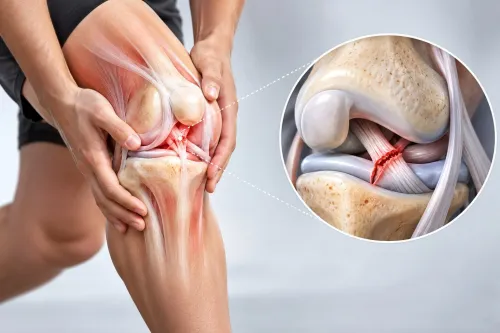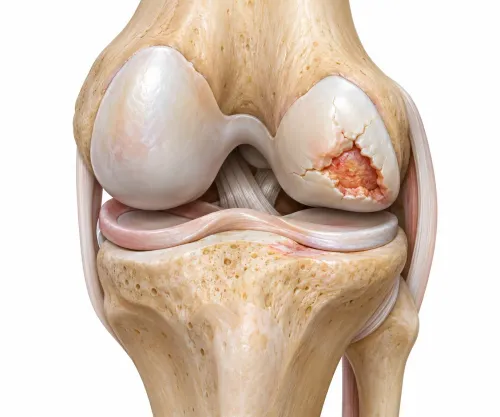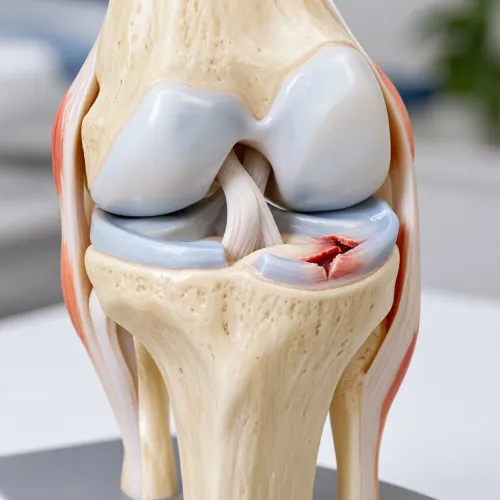
Knee pain that lasts beyond normal recovery can gradually reduce how far you walk, how well you sleep, and what you can do independently. By the end, you will know which symptoms require an orthopaedic consultation, what assessment involves, which treatments to try first, and when replacement becomes a reasonable discussion.
Key takeaways
- Pain lasting over 12 weeks warrants an orthopaedic assessment.
- Seek urgent care for a hot, swollen knee with fever or sudden inability to walk.
- Review exercise, weight management, medicines, and injections before surgery.
- Compare daily limitations and treatment results before considering knee replacement.
When Knee Pain Becomes Chronic and Needs an Orthopaedic Consultation
Pain lasting longer than 12 weeks is chronic knee pain, not ordinary post-activity soreness. Normal soreness follows a new or harder activity, eases with rest, and steadily improves over several days.
Persistent knee pain that returns during ordinary walking, remains unchanged, or limits your routine deserves medical assessment, even if you can still work or exercise.
Book an orthopaedic consultation if you have:
- Knee pain at rest or at night, particularly if it repeatedly disrupts sleep
- Swelling that keeps returning or does not settle after activity
- Locking, catching, or difficulty fully straightening the knee
- Giving way or a sudden loss of confidence when standing or walking
- A shorter walking distance than before
- Difficulty using stairs, rising from a chair, dressing, or completing other daily activities
Activity-related pain, brief morning stiffness, and reduced function often point towards knee osteoarthritis, but other conditions can produce similar symptoms. An examination can assess movement, strength, stability, alignment, and your walking pattern rather than relying on pain location alone.
Do not assume an abnormal X-ray explains every symptom. Joint changes can exist without pain, while persistent symptoms can also come from inflammatory arthritis, a meniscal problem, hip or spinal pain, or another cause. Arrange an assessment when symptoms continue despite reducing the provoking activity, or when pain begins affecting sleep, mobility, or independence.
Symptoms That Need Prompt or Urgent Medical Assessment
Book a routine orthopaedic appointment when knee pain persists, limits walking, or disrupts sleep and daily activities. Pain at rest or at night, a swollen knee that keeps returning, a locking knee, knee giving way, reduced walking distance, or difficulty using stairs all warrant specialist assessment.
| Symptom | Action | Reason |
|---|---|---|
| Persistent pain, stiffness, or swelling | Book a routine appointment | The cause may be osteoarthritis, meniscal damage, inflammatory arthritis, or referred pain |
| Locking knee, repeated giving way, or inability to complete daily tasks | Arrange prompt specialist assessment | Mechanical or structural damage may need targeted treatment |
| Hot, acutely swollen knee with fever or feeling unwell | Seek urgent medical assessment today | Septic arthritis can permanently damage the joint |
| Sudden inability to bear weight or a visibly deformed knee after injury | Seek urgent assessment | A fracture, dislocation, or major ligament injury needs rapid evaluation |
| Swollen calf with breathlessness or chest pain | Call emergency services immediately | This combination can indicate a blood clot and pulmonary embolism |
Do not wait for routine care if severe symptoms appeared suddenly. A hot knee without fever still needs prompt assessment when swelling and pain are new, because crystal arthritis and infection can resemble an osteoarthritis flare. Book specialist care even while pursuing weight management or exercise; you do not need to complete weight loss first.
How a Specialist Finds the Cause of Persistent Knee Pain
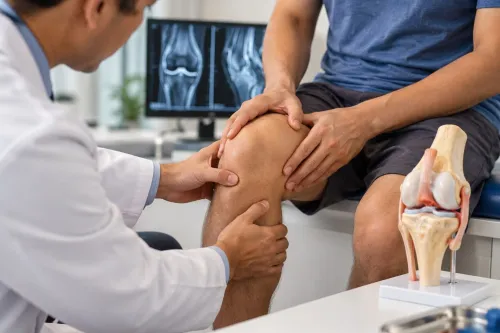
Knee pain diagnosis starts with your history, not a scan. The specialist asks where the pain occurs, how long it has lasted, whether it follows activity, and whether you have morning stiffness, swelling, locking, giving way, fever, or pain at rest.
They also review injuries, previous treatments, medicines, and conditions such as gout or inflammatory arthritis.
The examination covers your walking pattern, leg alignment, swelling, muscle strength, tenderness, range of motion, and knee stability. The specialist may also examine your hip and spine because pain from either area can be felt in the knee.
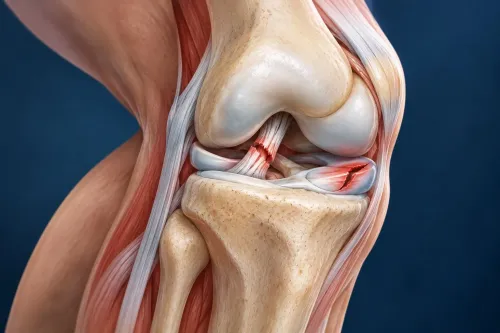
These findings help distinguish osteoarthritis from meniscal injury, ligament damage, inflammatory arthritis, crystal arthritis, infection, or referred pain.
Tests are selected according to those findings:
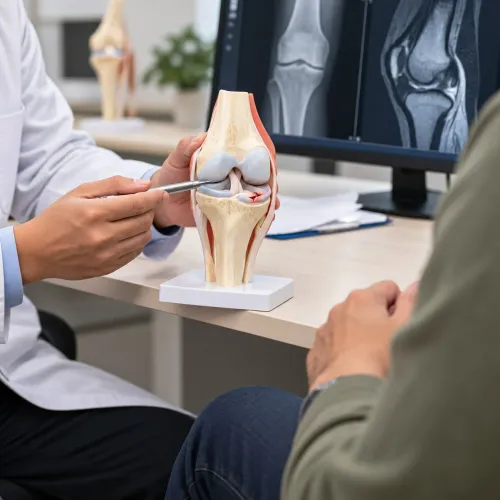
- A weight-bearing knee X-ray shows joint-space loss, bone spurs, alignment changes, and other signs of osteoarthritis. It is useful when symptoms persist, function is declining, the diagnosis is uncertain, or surgery is being considered.
- A knee MRI is reserved for suspected meniscal, ligament, cartilage, or bone problems that an X-ray cannot show, especially when the examination and X-ray do not explain your symptoms.
- Blood tests help investigate inflammation, infection, or conditions such as rheumatoid arthritis and gout; they are not routine for straightforward osteoarthritis.
- Joint-fluid analysis requires removing fluid with a needle. It checks for infection, crystals, and inflammatory cells when the knee is hot, acutely swollen, or the diagnosis is unclear.
A hot swollen knee with fever needs urgent assessment. Infection can permanently damage the joint and is not a routine osteoarthritis flare.
Non-Surgical Treatments to Try Before Knee Replacement
A knee replacement is usually not the first step. Begin with a structured plan that combines exercise, symptom relief, and weight management; pain can briefly increase when exercise starts, but stopping all movement weakens the joint further.
| Treatment | What it can do | Limits or risks |
|---|---|---|
| Knee physiotherapy | Builds strength, improves range of motion, balance, walking, and stair use | Exercises need regular practice; an unsuitable programme can aggravate pain |
| Strength training for knee osteoarthritis | Strengthens the quadriceps, hips, and hamstrings to improve load tolerance and function | Start gradually with supervised technique; severe pain, swelling, or instability needs review |
| Aerobic or aquatic exercise | Improves fitness without relying only on painful land-based activity | Pacing matters; overloading the knee can trigger a flare |
| Weight management | Any weight loss can reduce knee load; greater loss generally brings greater benefit | It is not a prerequisite for specialist assessment, and dieting alone will not restore damaged cartilage |
| Topical NSAIDs | Reduce local osteoarthritis pain with less whole-body exposure than tablets | Avoid them on broken skin; check allergies and follow the product dose |
| Oral NSAIDs or an injection | May provide stronger or short-term relief when other measures fail | Oral NSAIDs require assessment of stomach, kidney, liver, and cardiovascular risks; injections do not repair the joint |
Use a walking aid or brace only after assessment if pain or instability limits activity. Arrange specialist review when treatment is ineffective, unsuitable, or impossible to continue; do not keep escalating painkillers to postpone that decision.
When to Compare Continued Treatment with Knee Replacement
Discuss knee replacement when persistent knee symptoms now limit your life more than the treatment burden, and examination and imaging show damage that matches your symptoms.
A knee replacement consultation is reasonable for advanced knee osteoarthritis when persistent pain despite treatment affects sleep, walking, work, stairs, or personal care. Referral is not an automatic commitment to surgery; it lets a specialist compare the likely benefit with continued treatment.
| Decision point | Continue treatment | Discuss knee replacement |
|---|---|---|
| Pain and function | Symptoms remain manageable, and you can walk and complete daily tasks | Pain at rest or night, short walking distance, or difficulty with stairs and daily activities |
| Joint damage | Symptoms are mild, or imaging does not match the examination | Severe, matching joint damage with stiffness, deformity, or progressive loss of movement |
| Health | Exercise, medication, injections, or other care remains effective and safe | Treatment has failed, is unsuitable, or cannot continue safely |
| Personal goals | You accept current limits and can maintain valued activities | Pain and lost independence outweigh recovery time and surgical risks |
The specialist must confirm that osteoarthritis is the cause, rather than inflammatory arthritis, crystal arthritis, infection, hip or spinal pain, or another knee problem. A hot, acutely swollen knee with fever needs urgent assessment, not a routine replacement discussion.
Age, smoking, body-mass index, or another medical condition should not automatically prevent referral. Your overall health affects preparation and recovery, while your goals determine whether the expected improvement is worthwhile.
Dr Ronak Kothari can help assess whether disease is confined to one compartment, which is essential when comparing partial versus total knee replacement. A replacement does not create a normal knee; kneeling difficulty, stiffness, altered sensation, limited movement, or persistent pain can remain.
Related services
Knee Replacement Surgery Knee replacement surgery, or knee arthroplasty, is a procedure to replace a damaged knee joint with an artificial implant made of metal and plastic. View service → |
Partial Knee Replacement Dr. Ronak Kothari, a proficient Orthopaedic Surgeon, offers advanced Partial Knee Replacement (Unicompartmental Knee Replacement) procedures designed... View service → |
Frequently asked questions
When does knee pain become chronic and require an orthopaedic consultation?
Knee pain lasting longer than 12 weeks is chronic and warrants an orthopaedic consultation, especially when it limits walking, stairs, sleep, work, or exercise.
Which knee pain symptoms need prompt or urgent medical assessment?
Seek prompt assessment for worsening swelling, locking, repeated giving way, or pain after an injury. Seek urgent care for a hot swollen knee with fever, a deformed joint, sudden inability to bear weight, or severe pain after trauma.
How does a specialist find the cause of persistent knee pain?
The assessment includes your symptom history, walking pattern, knee movement, stability, swelling, tenderness, and alignment. The specialist may request weight-bearing X-rays and other tests when the examination indicates them.
What non-surgical treatments can you try before knee replacement?
Options include physiotherapy, strength and flexibility exercises, activity changes, weight management when appropriate, pain medicines, braces or walking aids, and injections selected for your condition.
When should you compare continued treatment with knee replacement?
Compare continued treatment with knee replacement when pain and stiffness persist despite appropriate non-surgical care and your knee limits walking, stairs, sleep, work, or everyday activities.
Related services
Knee Preservation Procedures Dr. Ronak Kothari, an experienced Orthopaedic Surgeon, specializes in Knee Preservation Procedures aimed at maintaining the natural knee joint for as... View service → |
Knee Arthroscopy & Sports Medicine Knee Arthroscopy & Sports Medicine Dr. Ronak Kothari, a skilled Orthopaedic Surgeon, specializes in Knee Arthroscopy and Sports Medicine, offering advanced, minimally invasive... View service → |
Robotic Joint Replacement Dr. Ronak Kothari, a leading Orthopaedic Surgeon, specializes in Robotic Joint Replacement Surgery, offering state-of-the-art precision and enhanced... View service → |
General Consultation ₹1000 General Consultation |